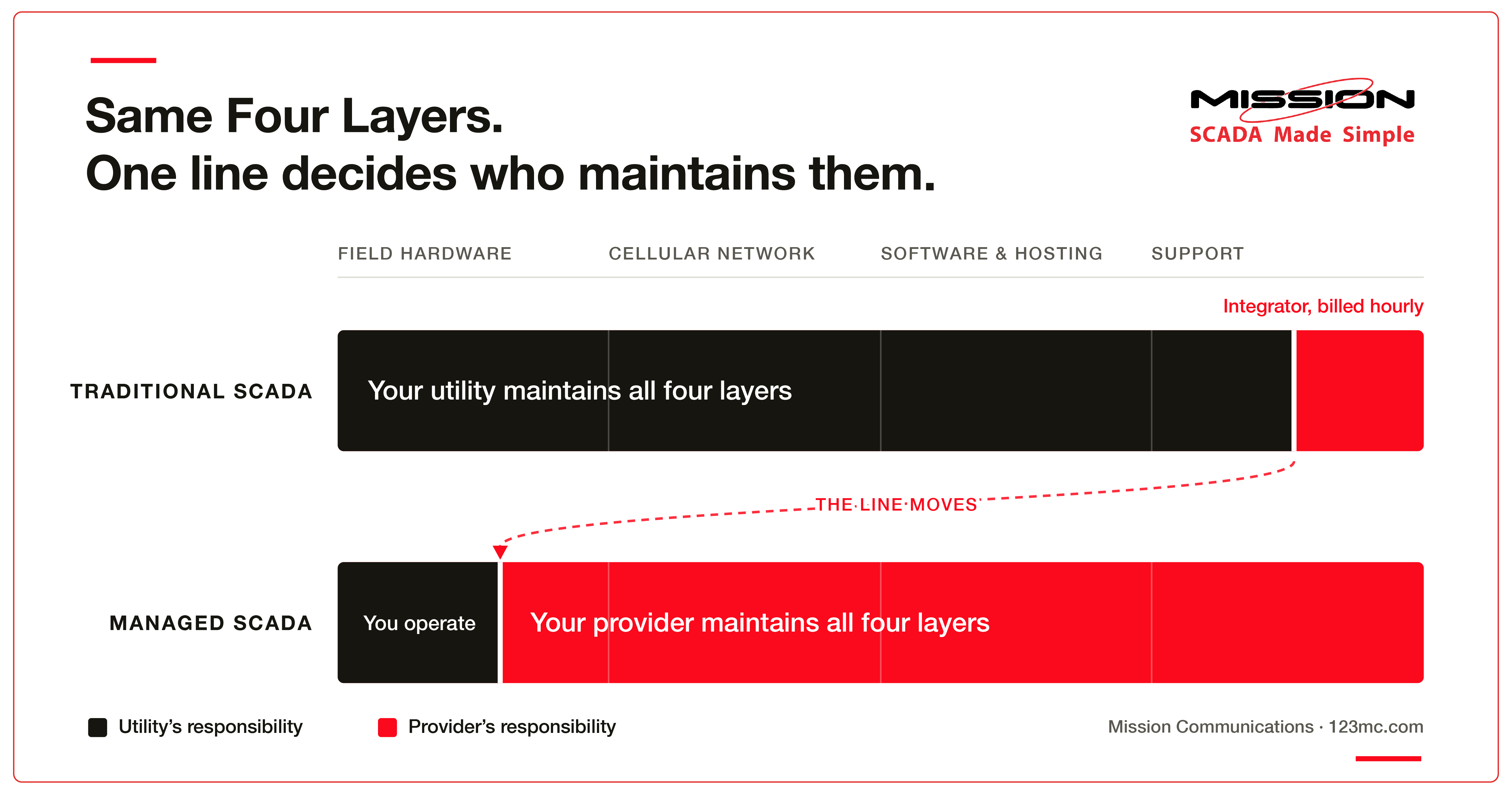
Ask ten people in the water industry to define SCADA and you’ll get ten answers. Ask them to define managed SCADA and the room gets quieter — which is a problem, because the difference between the two decides whether a small utility can afford remote monitoring at all.
Nearly 50,000 community water systems operate in the United States, and roughly 81% of them serve 3,300 people or fewer, according to Congressional Research Service analysis of EPA data. Those systems run the same lift stations, wells, and tanks as a big-city utility. What they don’t have is a control-systems department. This guide explains what managed SCADA is, what it includes, where it fits, and — since it comes up in every conversation eventually — what happens to it when the power goes out.
What is managed SCADA?
Managed SCADA is a subscription service in which a single provider supplies and maintains the entire monitoring system — the field hardware, the communication network, the software, the hosting, and the technical support — so the utility operates the system instead of building and maintaining it.
SCADA itself stands for supervisory control and data acquisition: the combination of field devices, communications, and software that lets an operator see what a pump station or tank is doing and, in many cases, act on it. Traditional SCADA delivers that as a project. A utility buys components from several vendors, hires an integrator to program them, owns the servers, licenses the software, and takes responsibility for keeping all of it running for the next fifteen years.
Managed SCADA delivers the same visibility as a service. Nothing about the underlying technology is simpler — the complexity just sits with the provider.
How is managed SCADA different from traditional SCADA?
| Traditional / DIY SCADA | SCADA géré | |
|---|---|---|
| Purchase model | Capital project, bid and integrated | Subscription service fee |
| Communications | Utility-owned radio, fiber, or leased line | Provider-managed cellular network |
| Software & hosting | Licensed and hosted on utility servers | Hosted and maintained by the provider |
| Upgrades & patching | Utility’s responsibility, often deferred | Included and applied by the provider |
| Expansion | New integration scope for each site | Add a site, add it to the subscription |
| Soutien | Integrator callout, billed hourly | Included technical support |
| Best suited to | Large plants, complex process control | Distributed assets, lean staffs |
The practical difference shows up in year six. A traditionally integrated system depends on the utility to keep servers patched, licenses current, and the one person who understood the programming still employed. EPA estimates that roughly one-third of the water sector workforce is eligible to retire within ten years — and in a small utility, that one person and the SCADA expertise often walk out the door together.
What’s included in managed SCADA?
Coverage varies by provider, but a genuinely managed offering includes four layers:
| Layer | What it covers |
|---|---|
| Field hardware | RTUs at each site, with sensor inputs for level, flow, pressure, runtime, power status, and alarms |
| Communications | Cellular data service on a carrier network, provisioned and paid for by the provider |
| Software | Hosted web and mobile access to real-time values, alarms, trends, and compliance reporting |
| Soutien | Configuration help, troubleshooting, alarm-routing changes, and firmware updates |
The billing test is a useful one: if the cellular data plan, the software hosting, and the support calls all arrive on separate invoices, the system is hosted SCADA rather than managed SCADA. Under a managed model, those pieces are one service — and rates are locked for the term of the agreement, with any change taking effect at renewal rather than mid-contract.
Who is managed SCADA a good fit for?
Managed SCADA tends to fit utilities that share a few traits:
- Assets are spread out. Lift stations, wells, tanks, and booster stations scattered across a service area are expensive to reach with utility-owned radio or fiber, and cheap to reach with cellular.
- Staff is small and multi-hatted. When the SCADA administrator is also the lead operator and the on-call tech, maintenance that can be outsourced usually should be.
- Capital is scarce but operating budgets are predictable. AWWA’s State of the Water Industry report ranks infrastructure renewal and financing as the sector’s top two challenges, with drinking water needs projected at $2.1 trillion over 25 years. A monthly service fee competes differently for funding than a capital request.
- The need is monitoring and alarming, not closed-loop process control. Most collection systems and distribution networks need to know and be told, not to run a plant-wide control strategy.
It’s a poorer fit where sub-second control logic, deep historian integration, or dense in-plant instrumentation dominates. Plenty of utilities run both: managed SCADA across the collection system, traditional SCADA inside the treatment plant.
What happens to managed SCADA in a storm?
This is the question that decides most evaluations, and it deserves a direct answer.
Climate Central’s analysis of federal outage data found that 80% of major U.S. power outages between 2000 and 2023 were weather-related, and that such outages roughly doubled over that period. Storm resilience isn’t a feature of a monitoring system — it’s the whole point of one.
A well-designed managed SCADA installation stays online through an outage because each layer has a fallback:
| Failure | How a managed system responds |
|---|---|
| AC power lost at the site | The RTU switches to battery and reports an AC failure alarm after a short delay, so operators learn which sites lost power without driving to them |
| Utility network or internet down | Cellular communication is independent of the utility’s own network and the site’s wired service |
| Cell tower congested or damaged | Signal-loss rules flag the device as unreachable, so a silent site is treated as an alarm rather than as good news |
| Operators displaced from the office | Hosted software means the system is reachable from a phone or laptop anywhere with coverage |
Two things that field experience makes clear: batteries are a consumable, generally replaced on a five-year cycle, and the utilities that recover fastest are the ones holding spare radios, antennas, transducers, and mainboards on a shelf. Damage diagnosis is rarely the bottleneck after a storm — parts availability is. For a deeper checklist, see our post on how cellular managed SCADA keeps utilities watching when the grid goes down.
Frequently asked questions
Is managed SCADA the same as cloud SCADA? Not quite. Cloud SCADA describes where the software runs. Managed SCADA describes who is responsible for the whole system — hardware, network, software, and support.
Does managed SCADA require IT staff? No. There are no servers to patch or licenses to renew, and access is through a browser or mobile app.
Can it control equipment, or only monitor? Both. Managed systems handle monitoring, alarming, and reporting, and support control functions such as starting and stopping pumps or adjusting setpoints.
How long does deployment take? Because the hardware arrives preconfigured and the network is already provisioned, sites are typically commissioned in hours, and utilities usually phase deployment station by station.
Is it secure? Cellular communication doesn’t expose the monitoring system to the utility’s business network, and patching is handled by the provider rather than deferred.
Mission Communications built its business around this model: Mission RTUs, cellular service, the 123SCADA platform, and technical support delivered as one managed service to water and wastewater utilities. If you’re weighing managed SCADA against a traditional build, our team is happy to walk through what your sites would actually require — reach us at Sales@123mc.com.