
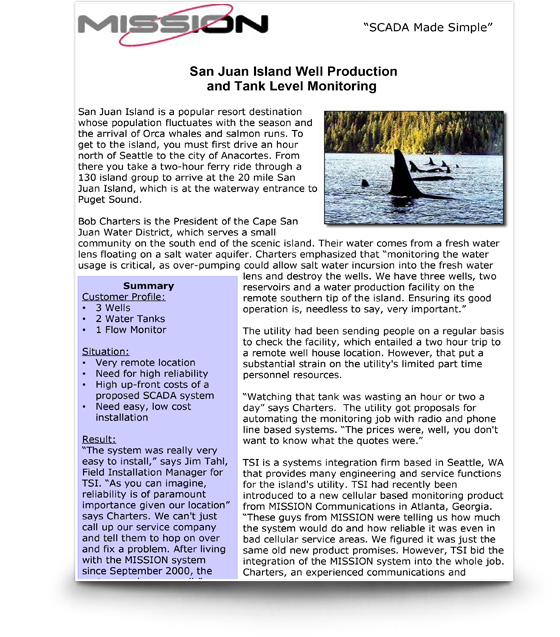
San Juan Island is a popular resort destination whose
population fluctuates with the season and the arrival
of Orca whales and salmon runs. To get to the island,
you must first drive an hour north of Seattle to the
city of Anacortes. From there you take a two-hour
ferry ride through a 130 island group to arrive at
the 20 mile San Juan Island, which is at the waterway
entrance to Puget Sound.
Profile
- 3 Wells
- 1 Water Tank
- 1 Flow Monitor
Situation
- Very remote location
- Need for high reliability
- High up-front costs of a proposed SCADA system
- Needed easy, low coast installation
Result
“The system was really very easy to install,” says Jim Tahl,
Field Installation Manager for TSI. “As you can imagine, reliability
is of paramount importance given our location” says Charters. We
can't just call up our service company and tell them to hop on over and
fix a problem. After living with the MISSION system since September 2000,
the system works very well.”
|
Bob Charters is the President of the Cape San Juan
Water District, which serves a small community on the south end of the scenic island.
Their water comes from a fresh water lens floating on a salt water aquifer.
Charters emphasized that “monitoring the water usage is critical, as over-pumping
could allow salt water incursion into the fresh water lens and destroy the wells.
We have three wells, two reservoirs and a water production facility on the remote southern
tip of the island. Ensuring its good operation is, needless to say, very important.”
The utility had been sending people on a regular basis to check the facility, which
entailed a two hour trip to a remote well house location. However, that put a substantial
strain on the utility's limited part time personnel resources.
“Watching that tank was wasting an hour or two a day” says Charters. The
utility got proposals for automating the monitoring job with radio and phone line based systems.
“The prices were, well, you don't want to know what the quotes were.”
TSI is a systems integration firm based in Seattle, WA that provides many engineering and
service functions for the island's utility. TSI had recently been introduced to a new cellular
based monitoring product from MISSION Communications in Atlanta, Georgia. “These guys
from MISSION were telling us how much the system would do and how reliable it was even in bad
cellular service areas. We figured it was just the same old new product promises. However, TSI bid the integration of the MISSION system into the whole job. Charters, an experienced
communications and computer engineer, accepted TSI's bid with only a few reservations.
They were about the ability of the MISSION unit to make a cellular connection in this remote
part of western Washington, the MISSION Control central computer facility, and the web site
development.
Cellular, but Without the Problems
MISSION's system uses a special cellular data technology called Cellemetry, which was invented
by BellSouth. Carriers normally use cellular digital control channels to send call setup and
billing data. MISSION uses these same channels to send RTU alarms, tests, and other supervisory
information. All this is done over the highly reliable cellular infrastructure, but without
actually making a phone call, and thus is not subject to busy signals or dropped calls.
Cellemetry technology has been used in the burglary and fire alarm industry since 1997.
MISSION
management founded the first company to ever use the BellSouth technology. It is estimated
that the life/safety alarm industry alone has deployed over 150,000 devices using this technology
because of its advantages over phone lines and regular voice cellular.
Charters remembers asking, “Well, if this doesn't work like an autodialer with a regular
cellular dialup, how does it call me and give me alarms? How do I see my tank level and
well production data? I surely though buying more equipment, like a SCADA computer and software,
was going to be involved.” However, with MISSION you don't need a separate SCADA
computer. MISSION uses a large computer facility in Atlanta to present data and SCADA screens
to the user over a secure Internet link to the customers' existing computers. Within a second
or two after the field RTU transmits the alarm, the “data packet” reaches
MISSION's
central computer facility in Atlanta, and a redundant facility in Cincinnati. From there the
alarms are automatically forwarded to the customer's on-duty personnel. Automated computers
deliver notifications to phones, cell phones, numeric pagers, alphanumeric pagers, faxes or
e-mail addresses for any number of recipients on a call-out list.
“As fast as you can dial a long distance number and hear it ring at the other end is as
fast as we get these signals; nationwide. The best news is that the service will be around
as long as cellular, and the cellular carriers maintain the radio towers and equipment.
We just ride along on the data backbone of the multi-billion dollar cellular network,”
says John Collings, President of MISSION Communications. “Once MISSION's servers receive
imagine having a half-a-dozen robotic operators at your disposal to get in touch with on-duty
personnel any way you like. The computers never get tired and they don't forget.”
Alarms, Analog Levels, Flow and Pump Run Times
TSI made the trek to the remote site and installed a single MISSION
Model 100 RTU. The RTU was installed inside the well pump house and connected to monitor and
report general alarms, pump failure alarms, pump run times for all three wells, one 4-20 mA
tank level sensor, and a pulsing output from a flow meter. On a daily basis the system reports
cellular service diagnostics, pump runtimes, cumulative flow, the daily high and low tank
levels and the current tank level at midnight. High or low tank levels or other alarms are
reported immediately.
“The system was really very easy to install,” says Jim Tahl,
Field Installation Manager for TSI. “The only trouble I had was when I called with
a question for MISSION tech support. I had to climb one quarter mile to the top of a hill
before my cell phone would work properly!”
Reliable Alarm Notifications and Web Site SCADA
“The San Juan Island installation is a testament to the unparalleled national coverage
and reliability of the cellular digital control channels and the Cellemetry service,”
said Collings. Even though the cellular service is poor in the area,
MISSION recorded a 96%
first transmission success rate, with 100% of the transmissions getting through within 40
seconds. Charters uses MISSION's web based SCADA screens to check and analyze well pump
performance, water usage and water tank levels. “At first I would check the site almost
every day, but as time went by, and my confidence in the system grew, I realized the system
would reliably alert me to problems and my analysis of the sites performance only needed
to be weekly. In the beginning, I encountered some problems with web site access. They
proved to be issues with our Internet provider and some settings on my new computer. I
found that even if I had web access problems, my alarm notifications worked smoothly.
Other than that, the system has worked very reliably,” said Charters.
Unexpected Reliability
“As you can imagine, reliability is of paramount importance given our location”
says Charters. “We can't just call up our service company and tell them to hop on over and
fix a problem. After living with the MISSION system since September 2000, the system works
very well.”
MISSION is based in Atlanta, Georgia and introduced its products and services to the water
and wastewater industries in early 2000. MISSION has units throughout North America, from
Vancouver, BC to Miami, FL to International Falls, MN. Information about
MISSION and its
products can be found on the web at www.123mc.com.
|