Most people, not just golfers, recognize the name Pebble Beach as
being one of the premier residential communities in the nation. Nestled on the
shoreline and bluffs of the California Monterey peninsula, Pebble Beach is
home to hundreds of multi-million dollar estates and some of the most meticulously
maintained golf courses in the world. One course, the Pebble Beach golf links,
hosts the annual Pebble Beach Pro/Am golf tournament. With such high profile
residents and guests enjoying the panoramic vistas of the Pacific and mountains,
imagine the environmental and economic losses, not to mention the political
uproar, if a sewer spill occurred. The management of the Pebble Beach Community
Services District does, as it has demonstrated by maintaining a long-standing
record of pump station reliability. However, after a number of recurring
communication failures with their phone line based SCADA system, they decided
it was time to improve the monitoring reliability of their system.
Customer Profile
- 1.2 MGD system
- 8 lift stations
- 1 "Interceptor" Flow Monitor
- 1 Tank Level Monitor
Situation
- Environmentally, economically and politically sensitive sites
- Cut phone lines and slowing repair service
- Alarms not reported
- “Zero tolerance” EPA and District
- Up front high costs and integration problems with backup system
- Ugly, visible YAGI antennas and masts
Result
“It's a little embarrassing. We bought MISSION as a backup to our existing SCADA.
In many areas it out performs the primary system. It's certainly a heck of a lot less
expensive and easier to use.”
|
“From management to the field operators, our District's fiduciary responsibilities concerning
collection system operation are the same as any other sewer operators. If we ever had a spill
in our service area, the 'beheadings' might be a little more public and spectacular than others,
but the result will be the same for any unprepared operator. The Federal and State EPA mandates
are quite clear, no spills. Those kind of press conferences are unacceptable to our board
members,” says Frank Rose, District Maintenance Manager for the Pebble Beach Community Services
District. With construction mishaps, fiber upgrades and normal maintenance, more and more
“copper” phone line services (dedicated or dial-up) are subject to interruptions.
Add in the economizing that most local telephone companies are being forced into, and hour-long
problems are turning into days. Couple this with a “zero tolerance” by District managers
and the EPA, and redundancy starts to become standard operating procedure.
“Our initial logic was pretty straight forward. We have 2 or more pumps at every lift
station for redundancy. We all know that any machine (or system) can break for a variety of reasons.
Why not extend that type of safeguard to the monitoring and control system.” But at what cost?
The district looked at the feasibility for both licensed and unlicensed (spread spectrum) radio based
SCADA monitoring systems. The upfront costs were high and integration of the two systems appeared
difficult. Additionally, through conversations with other radio based SCADA users, questions arose
about the true reliability and ongoing maintenance issues of such a system. “There were a
number of times we felt we would be creating more problems than we'd be solving,” says Rose.
“The final straw was the anticipated resident reactions to YAGI antennas and their pole masts
sticking up in the air at the lift stations on the golf courses; it just wasn't going to fly.”
A few months later the District was given a demonstration of the MISSION Communications cellular
based SCADA/monitoring system by Dave Nemiroff of Nemiroff, Monahan & Associates, a consulting
engineer to the District. “I had read about the MISSION system in trade magazines, but because
of the low price and my prior experiences with cellular, I really didn't think the system would meet
our expectations. But my customer seemed to be at an impasse, so I arranged a demo” says Nimeroff.
“We were down right amazed at the capabilities and simplicity of the system. If it worked as
advertised, we felt we had a solution,” says Nemiroff. A trial installation was agreed to.
Wireless Data Over the Public Cellular Network
MISSION's system uses a special cellular data technology called Cellemetry, which was invented by
BellSouth. Carriers normally use cellular digital control channels to send call setup and billing
data. MISSION uses these channels to send RTU alarms, tests, and other supervisory information.
All this is done over the highly reliable cellular infrastructure, but without actually making a
phone call, and thus is not subject to busy signals or dropped calls. Cellemetry technology has
been used in the burglary and fire alarm industry since 1997, and they have deployed over 150,000
devices using this technology.
Frank remembers asking, “Well, if it doesn't make a phone call, then how do I get my alarms
and lift station status information? I figured they were going to require us to buy a central
SCADA computer. Then I thought, great, now we have two systems to maintain.” However,
with MISSION you don't need a separate SCADA computer. MISSION uses a large computer facility
in Atlanta to present data and SCADA screens to the user over a secure Internet link to the
customers existing computers. Within a second or two after the field RTU transmits the alarm,
the data reaches MISSION's central computer facility in Atlanta. From there the alarms are
automatically forwarded to the customer's on-duty personnel. Automated computers can deliver
notifications to phones, cell phones, numeric pagers, alphanumeric pagers, faxes or e-mail
addresses for any number of recipients on a call-out list. The MISSION alarm and
supervisory data can even be fed seamlessly into existing open architecture SCADA computers
such as Wonderware, Intellution or Rockwell Automation RS View.
“As fast as you can dial a long distance number and hear it ring at the other end is as fast
as we get these signals; nationwide. The best news is that the service will be around as long
as cellular, and the cellular carriers maintain the radio towers and equipment. We just ride
along on the data backbone of the multi-billion dollar cellular network,” says John Collings,
President of MISSION Communications.
“Once we have received the data, robotic operators
at your disposal to get in touch with on-duty personnel any way you like. The computers never
get tired and they don't forget.”
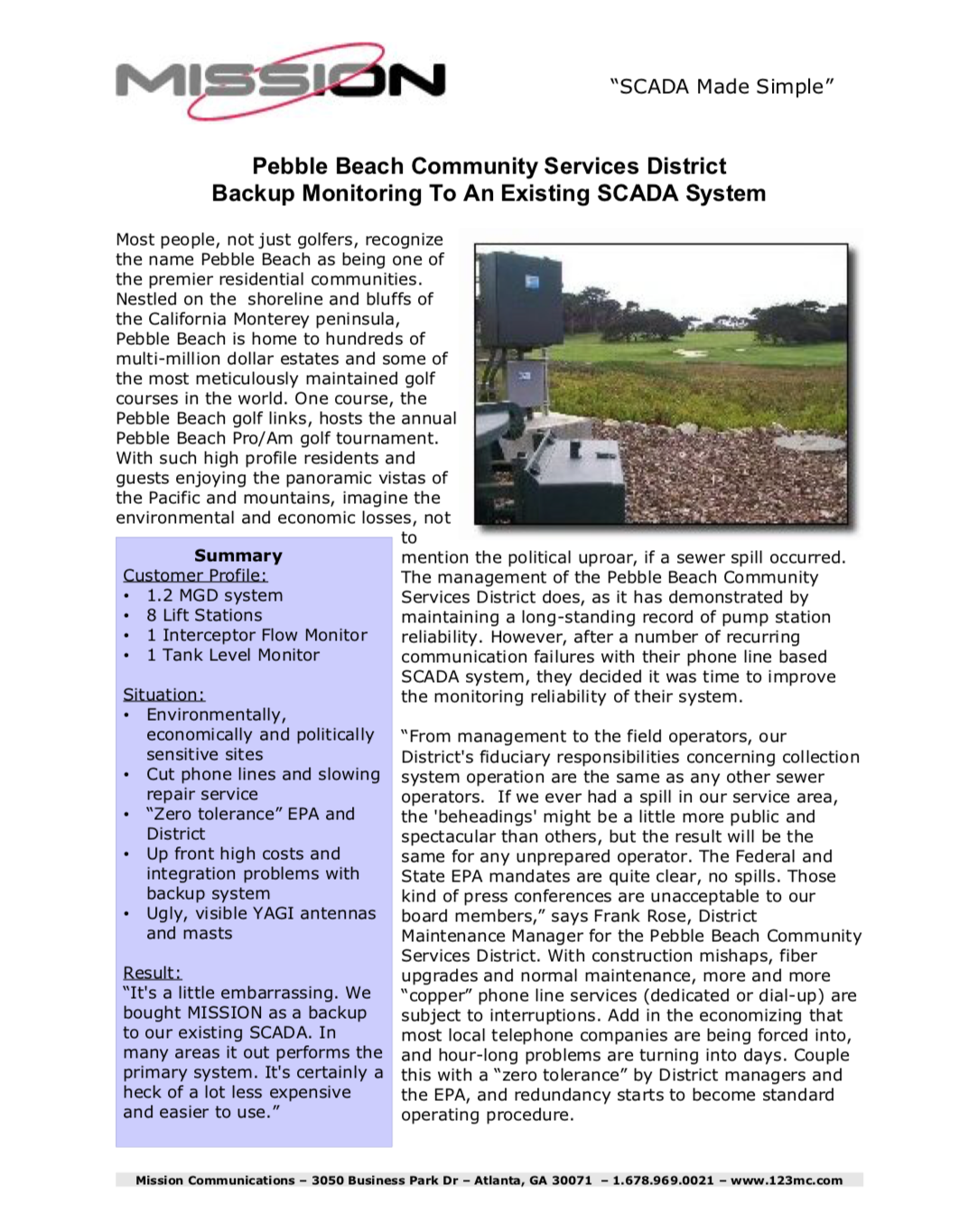
The initial trial unit in Pebble Beach was installed on a submersible duplex pump station housed
in an underground vault. The MISSION system monitors AC failure, high level, low level, phase
loss (through a phase monitor) and two pump runtimes. The RTU was installed with a MISSION-supplied
low profile, attack resistant, antenna. This was done to respect the District's desire to minimize
public exposure to any antennas. “After the unit was first installed, we got a phone call
from MISSION's Technical Support Group. They had detected through their diagnostics that the
trial unit had poor cellular signal strength and was occasionally going off-line,” says
Nemiroff. “I decided to look at the installation in depth and found that the
installer had taken the District's instructions on “hidden from view” antennas
a little far. The antenna had actually been mounted below ground in the lift station access
vault. I was surprised the RTU worked at all -- it was like trying to use a cell phone from
a sub basement elevator.”
Flow Monitoring and Tank Levels
After the initial confusion over antenna placement, the trial went smoothly and the District
subsequently installed RTU's on all eight of its lift stations. Soon thereafter, the
District ordered more RTU's to monitor the flow to the wastewater interceptor line, and to
monitor levels at their water storage tank. “We were extremely pleased with the system's
performance so we started to take advantage of some of the other capabilities it
offered,” says Rose.
Unexpected Performance
“It's a little embarrassing. We bought MISSION as a backup to our existing SCADA.
In many areas it outperforms the primary system. It's certainly a heck of a lot less expensive
and easier to use,” says Rose.
Other early adopters in the Monterey area are the Monterey Regional Water Pollution Control
Agency and Carmel Area Wastewater District. MISSION is based in Atlanta, Georgia, and introduced
its products and services to the water and wastewater industry in early 2000. MISSION has units
throughout North America from Vancouver, BC to Miami, FL to International Falls, MN.
Information about MISSION and its products can be found on the web at www.123mc.com.
|