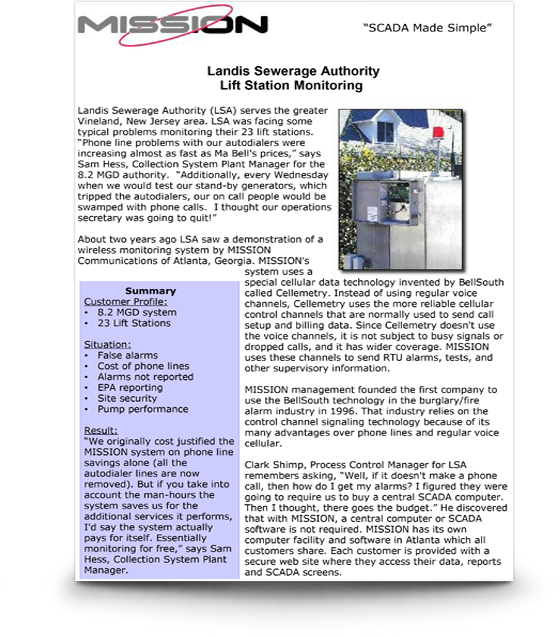
Landis Sewerage Authority (LSA) serves the greater Vineland, New Jersey area.
LSA was facing some typical problems monitoring their 23 lift stations.
“Phone line problems with our autodialers were increasing almost as fast
as Ma Bell's prices,” says Sam Hess, Collection System Plant Manager
for the 8.2 MGD authority. “Additionally, every Wednesday when we
would test our stand-by generators, which tripped the autodialers, our on call
people would be swamped with phone calls. I thought our operations
secretary was going to quit!”
Profile
- 8.2 MGD system
- 23 Lift Stations
Situation
- False Alarms
- Cost of Phone Lines
- Alarms not reported
- EPA Reporting
- Site Security
- Pump Performance
Result
“We originally cost justified the MISSION system on phone line savings alone (all
the autodialer lines are now removed). But if you take into account the man-hours the
system saves us for the additional services it performs, I'd say the system actually
pays for itself. Essentially monitoring for free,” says Sam Hess, Collection
System Plant Manager
|
About two years ago LSA saw a demonstration of a wireless monitoring system
by MISSION Communications of Atlanta, Georgia. MISSION's system uses a special
cellular data technology invented by BellSouth called Cellemetry. Instead of
using regular voice channels, Cellemetry uses the more reliable cellular control
channels that are normally used to send call setup and billing data. Since
Cellemetry doesn't use the voice channels, it is not subject to busy signals or
dropped calls, and it has wider coverage. The control channels are always on and
work without actually making a phone call. MISSION uses these channels to send
RTU alarms, tests, and other supervisory information.
MISSION management founded the first company to ever use the BellSouth technology
in the burglary/fire alarm industry in 1996. It is estimated that the life/safety
alarm industry alone has deployed over 150,000 devices using Cellemetry, and relies
on the control channel signaling technology because of its many advantages over
phone lines and regular voice cellular.
Clark Shimp, Process Control Manager for LSA remembers asking, “Well, if it
doesn't make a phone call, then how do I get my alarms? I figured they were going
to require us to buy a central SCADA computer. Then I thought, there goes the
budget.” He discovered that with MISSION, a central computer or SCADA
software is not required. MISSION has its own computer facility and software
in Atlanta which all customers share. Each customer is provided with a secure web
site where they access their data, reports and SCADA screens.
About one second after MISSION's field RTU transmits the alarm or supervisory
information over the control channel to the nearest cellular tower, the data packet
reaches MISSION's central computers. “As fast as you can dial a long
distance number and hear it ring at the other end is as fast as we get these alarms
nationwide”, says John Collings, President of MISSION Communications.
In a fraction of a second, MISSION's computer facility converts the cellular data
bytes into a text or voice message, then relays it to the customer's on duty
personnel. MISSION can deliver alarm messages to regular or cellular telephones,
numeric or alphanumeric pagers, can send a fax or email, or notify via the
customer's web site. The system can call any number of recipients on a typical
call-out list, and the list can change by time of day or day of week.
“Once we have these signals, imagine having a room full of robotic operators
at your disposal to get in touch with on-duty personnel any way you like.
The computers never get tired and they don't forget,” says Collings.
Each alarm requires that one of the recipients acknowledge the alarm, otherwise
additional notifications are made.
Reduced False Alarms, Increased Reliability and Documents Inspections
Since the call-out list can be changed by time of day or day of week, MISSION set
up LSA's system so the Wednesday stand-by generator tests were emailed to LSA,
while all other alarms, or generators running at other times, were processed as
full alarms with call-out. “I got my Wednesday mornings back!” says
Margaret Miller, operations secretary at LSA.
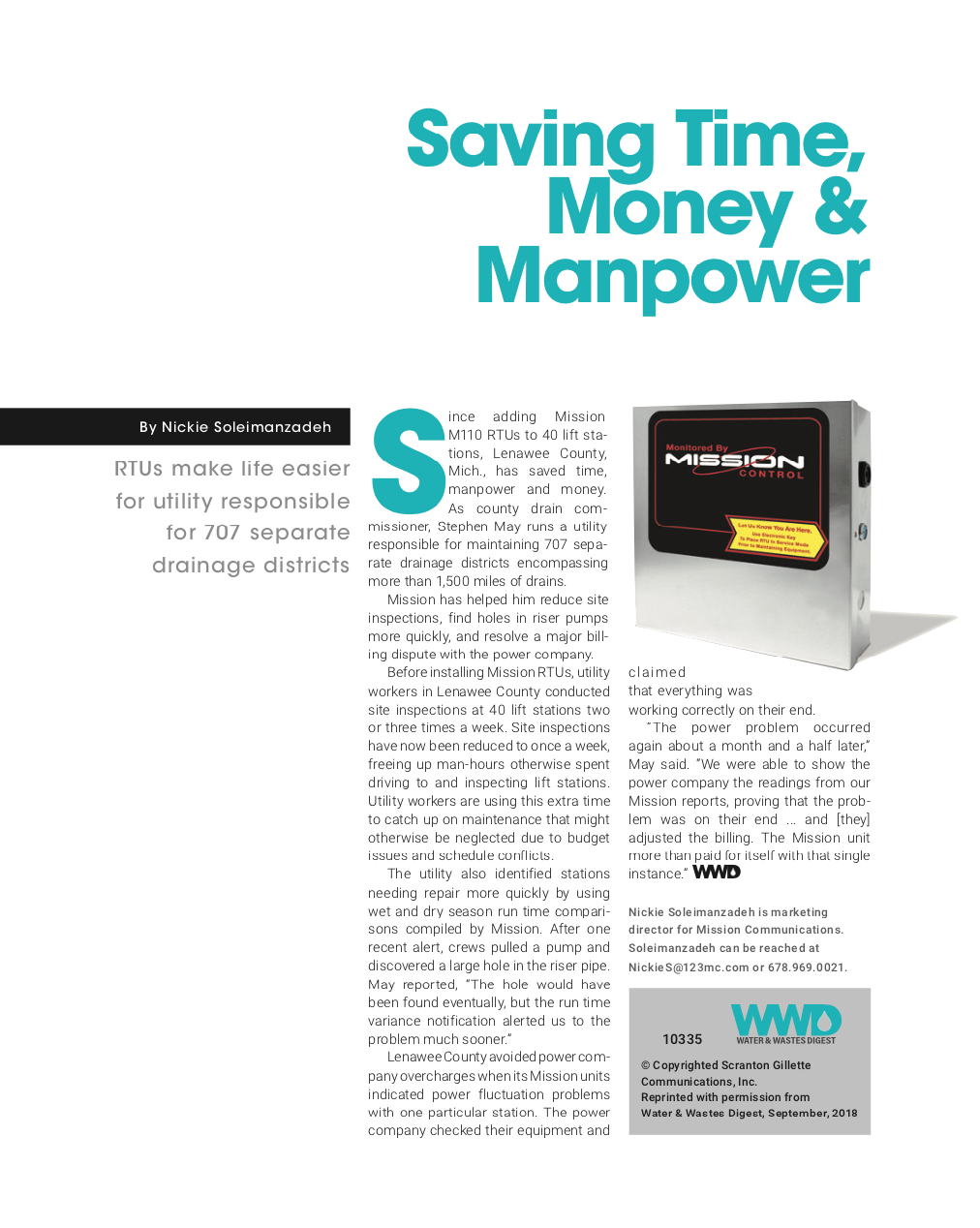
All MISSION field RTU's have electronic key readers installed on them. LSA
personnel were issued small electronic keys that are weatherproof and fit easily
on their key rings. The keys uniquely identify each key holder and can be used
on any field RTU. Whenever anyone inspects or performs maintenance at a field
station, they simply touch their key to the MISSION RTU key reader. That puts
the RTU in “service mode” which automatically stops alarm notifications.
It also sends a message to MISSION logging who checked in at the station and the
time. When field technicians “keys out” and leave, the RTU is put back
online and another message logs the time they completed the service. If they
forget to “key out”, the RTU will automatically bring itself back
online an hour later. “We get fewer false alarms, better system reliability,
a report we can use for the State EPA documenting when we performed maintenance
and inspections, and documentation of how quickly we responded to any alarms,”
says Sam Hess.
Another problem the MISSION system solved was the accidental alarms generated when
personnel performed maintenance on the sites. “The mechanics were supposed
to turn off the autodialers when they were working at the stations. Either they
wouldn't turn them off, causing false alarms, or they would turn them off and never
turn the darn things back on, and we'd miss alarms. Of course, we could never
prove this and nobody would ever admit to it,” says Bill Quigley, LSA
senior electrician.
Increased Security
In the aftermath of the recent terrorist attacks, everyone has an increased awareness
of security at all levels of water and wastewater operations. MISSION and LSA are
modifying the field RTU's so that the electronic key use will be used to authorize
entry to pump stations. The key readers will be relocated on the outside of the
stations and entry intrusion detection devices added. Field personnel will use the
keys to disarm RTU intrusion inputs. “Though the MISSION system is not intended
to be a burglar alarm, it is a natural extension of the systems abilities and it's easier
to use than other alarm systems we've seen,” says LSA.
System Monitors Pump Performance
Calling out alarms is just scratching the surface of what the MISSION system can do.
Each night the system reports individual pump runtimes for the day, and it even
keeps track of the time when pumps are running simultaneously. All the run times
are logged and graphed on the customers web site for reference and trending.
To provide additional value, the pump run times are analyzed daily for variances.
“We don't look for simple percentage changes in pump run times. We use complex
statistical algorithms that take into account each pumps operational characteristics
over a long period of time. When we see a change, we automatically notify the
customer,” says Collings. The pump run time variance alerts are sent via fax,
email or pagers during work hours if problems are detected. “It would take
us an hour or two every day to do what MISSION does. It has already alerted us to
several cases of operator error, bad check valves, air bound pumps and broken
controllers. There are maintenance issues we're picking up now that we just never
would have seen without this system. That will definitely prolong the useful life
of our pumps,” says Quigley.
Unexpected Savings
“We originally cost justified the MISSION system on phone line savings alone
(all the autodialer lines are now removed) as MISSION's service price is much less
expensive than a phone line. But if you take into account the man-hours the system
saves us for the additional services it performs, I'd say the system actually pays
for itself; essentially monitoring for free,” says Hess.
Other early adopters in the New Jersey area are the Borough of Haddonfield, Egg Harbor
and the City of Millville. MISSION is based in Altanta, Georgia, and introduced its
products and services to the water and wastewater industry in early 2000. MISSION
has units throughout North America from Vancouver, BC to Miami, FL to International
Falls, MN.
|